Protein in Haircare: Is It Good or Bad for Your Hair?
Protein in Haircare: Is It Good or Bad for Your Hair?
Protein in haircare is one of the most talked-about topics when it comes to damaged hair, dryness, breakage and hair extensions.
You've probably heard that protein treatments can make hair feel stronger. You may also have heard people say that too much protein can leave hair feeling stiff, brittle or dry.
So which is true?
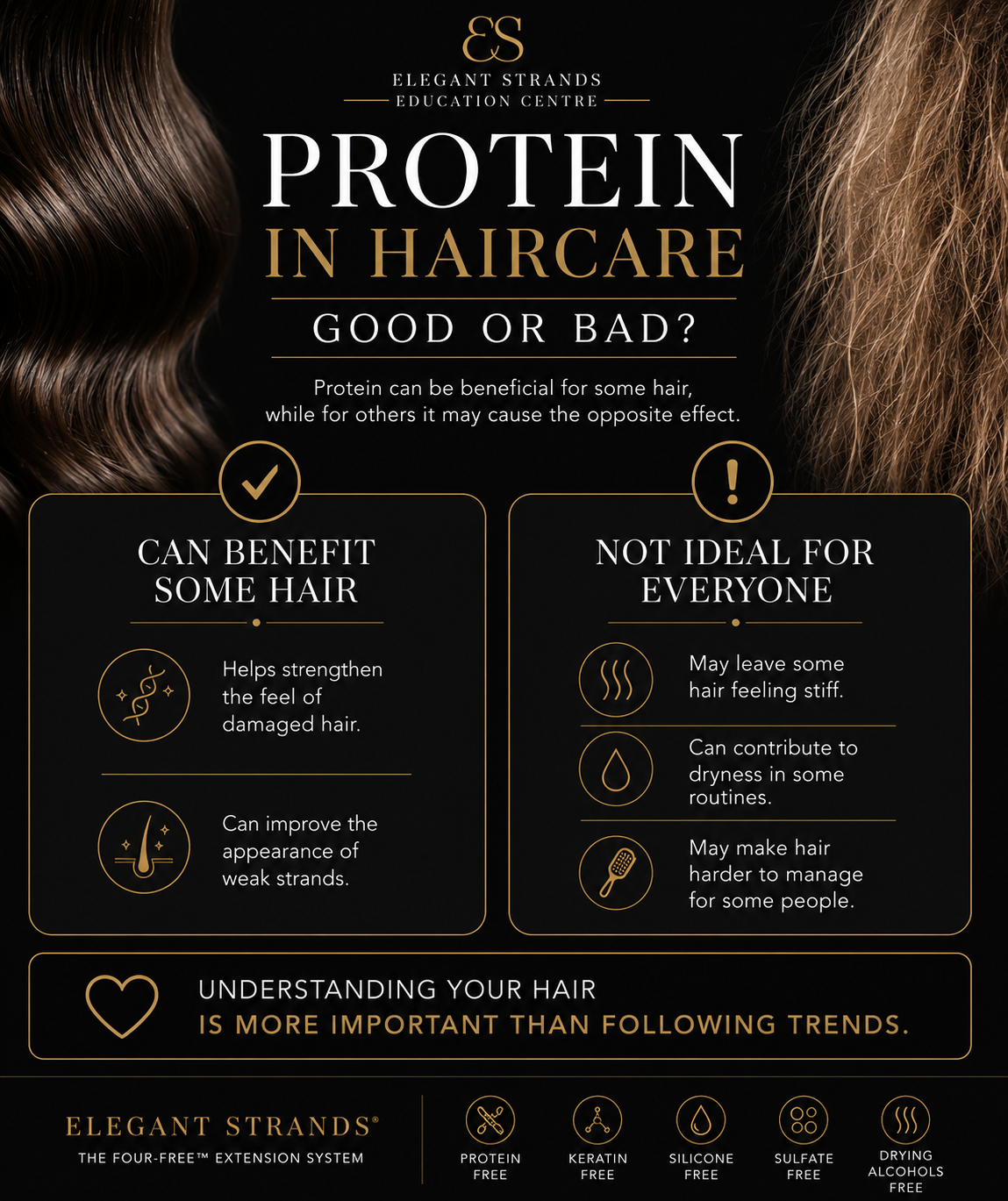
The answer isn't as simple as saying protein is good or bad. Different protein ingredients serve different purposes, and the way a product performs depends on its complete formulation, how frequently it's used and the condition of your hair.
At Elegant Strands Professional, we've chosen a moisture-focused, protein-free formulation approach for our extension-safe haircare range.
Here's what you need to know before deciding whether protein-based products belong in your routine.
What Is Protein in Haircare?
Human hair is made primarily of keratin, a structural protein that gives hair much of its strength and shape.
The protein ingredients added to shampoos, conditioners and treatments are different from the intact structural proteins already present in the hair shaft.
Some formulas include hydrolysed proteins, which have been broken down into smaller fragments.
These ingredients may be derived from sources such as wheat, rice or silk, or from keratin.
Depending on the formulation, they may help improve the temporary feel of the hair, form a conditioning film or reduce friction between strands.
However, a protein-containing product cannot permanently rebuild every damaged part of the hair shaft.
Is Protein in Haircare Good for Damaged Hair?
Protein-based products can be useful in certain formulations, particularly when the hair has undergone colouring, bleaching, heat styling or other processing.
Some treatments are designed to temporarily improve smoothness, manageability or the appearance of weakened hair.
That doesn't mean every damaged hair type needs additional protein.
Hair condition varies depending on previous treatments, natural texture, porosity, styling habits and the types of products already being used.
A product's effectiveness also depends on the other ingredients included alongside the protein.
For some people, a conditioning routine without added protein may be preferable.
Can Protein in Haircare Make Hair Feel Dry?
Some people report that their hair feels stiff, rough or difficult to manage after using certain protein-based treatments.
This experience is sometimes described online as protein overload.
However, the term isn't a precise medical or scientific diagnosis.
Hair may feel dry or brittle for several reasons, including chemical damage, repeated heat styling, inadequate conditioning, product buildup or a particular formula not suiting the hair.
It's difficult to determine whether protein itself is responsible without considering the complete product and the person's existing hair condition.
If a treatment consistently leaves your hair feeling rough, reducing how often you use it or changing products may be reasonable.
Persistent breakage should be assessed rather than automatically blamed on one ingredient.
What Does Protein Overload Actually Mean?
The phrase protein overload is widely used in haircare discussions to describe hair that reportedly becomes stiff or brittle after repeated protein treatments.
But hair doesn't simply absorb unlimited protein until it becomes permanently overloaded.
Different protein ingredients vary in molecular size, concentration and how they interact with the hair surface.
The overall formulation determines much of the finished result.
If your hair begins feeling rough after adding several new treatments, review the entire routine, including shampoo, conditioner, styling heat and previous chemical processing.
Don't assume the solution is necessarily to remove every protein ingredient forever.
Protein in Haircare Versus Moisture-Focused Conditioning
Protein-focused and moisture-focused products aren't always opposites.
A formula can include protein ingredients alongside conditioning agents, oils and humectants.
Similarly, a protein-free product can still be designed to improve softness and manageability.
The more useful question is whether the finished product suits your hair's condition and intended routine.
At Elegant Strands Professional, we've chosen to formulate without added protein or keratin because our range was developed around a coordinated, moisture-focused approach to hair extension aftercare.
This is a formulation choice rather than proof that protein ingredients are universally harmful.
Should Hair Extensions Use Protein Treatments?
Hair extensions may have different care requirements from natural hair, particularly because extension hair can be processed, coloured or chemically treated before installation.
Unlike growing hair, extension lengths don't receive ongoing natural oil distribution from the scalp.
They can also experience friction, tangling and repeated styling wear.
Some hair extension manufacturers recommend avoiding certain products, including specific protein treatments, depending on how their hair has been processed.
Other suppliers may provide different aftercare advice.
Protein in haircare isn't automatically unsuitable for every type of extension, but it's important to follow the recommendations supplied with your particular extension hair.
If you're unsure, ask your extension specialist before introducing a concentrated treatment.
Can Protein Treatments Repair Hair Extensions?
Haircare treatments can temporarily improve the feel and appearance of extension hair.
However, they cannot permanently reverse every type of processing damage or restore severely compromised hair fibres to their original condition.
If extensions repeatedly become rough, tangled or difficult to manage, the issue may involve their quality, previous processing, heat exposure or daily handling.
Adding more concentrated treatments isn't always the answer.
A professional assessment can help determine whether a change in routine is appropriate or whether the extension hair needs replacing.
How to Tell If Your Haircare Routine Is Suitable
Rather than focusing exclusively on whether a product contains protein, pay attention to how your hair behaves.
Useful questions include:
-
Does your hair feel manageable after washing?
-
Can you detangle it without excessive pulling?
-
Does it become unusually rough after a particular treatment?
-
Are the lengths exposed to frequent high heat?
-
Have you recently bleached or chemically processed your hair?
-
Are you using several intensive treatments together?
-
Are your extension attachments being cared for correctly?
If your hair feels uncomfortable or begins breaking, consider all possible contributing factors.
Changes in scalp health, shedding or significant breakage may warrant qualified professional advice.
Understanding Different Types of Protein Ingredients
Protein ingredients may appear on product labels under several names.
Hydrolysed Keratin
Hydrolysed keratin is used in some products marketed for processed or damaged hair.
Its performance depends on the formula and the condition of the hair.
Hydrolysed Wheat Protein
Wheat-derived protein fragments can be included in conditioning products to help improve the feel or appearance of hair.
Hydrolysed Rice Protein
Rice-derived proteins are used in certain formulas for conditioning and cosmetic haircare purposes.
Silk Protein
Silk-derived protein ingredients can be used to support cosmetic smoothness and conditioning.
These ingredients shouldn't be treated as interchangeable, and the name alone doesn't indicate how effective a finished product will be.
Why Elegant Strands Professional Uses Protein-Free Formulas
Elegant Strands Professional was developed by a hair extension specialist in Craigieburn, Melbourne.
Our goal was to create a coordinated collection designed with extension wearers in mind, while also being suitable for natural, coloured, bleached and chemically treated hair.
We chose to develop a range without added protein or keratin as part of our moisture-focused formulation philosophy.
We also avoid silicones, sulfates, parabens and drying alcohols.
These exclusions form our Four-Free Extension System™.
They're intended to describe our products accurately, not to suggest that every alternative haircare formula is unsafe.
Meet the Four-Free Extension System™
Our collection includes four complementary products designed for cleansing, conditioning and finishing.
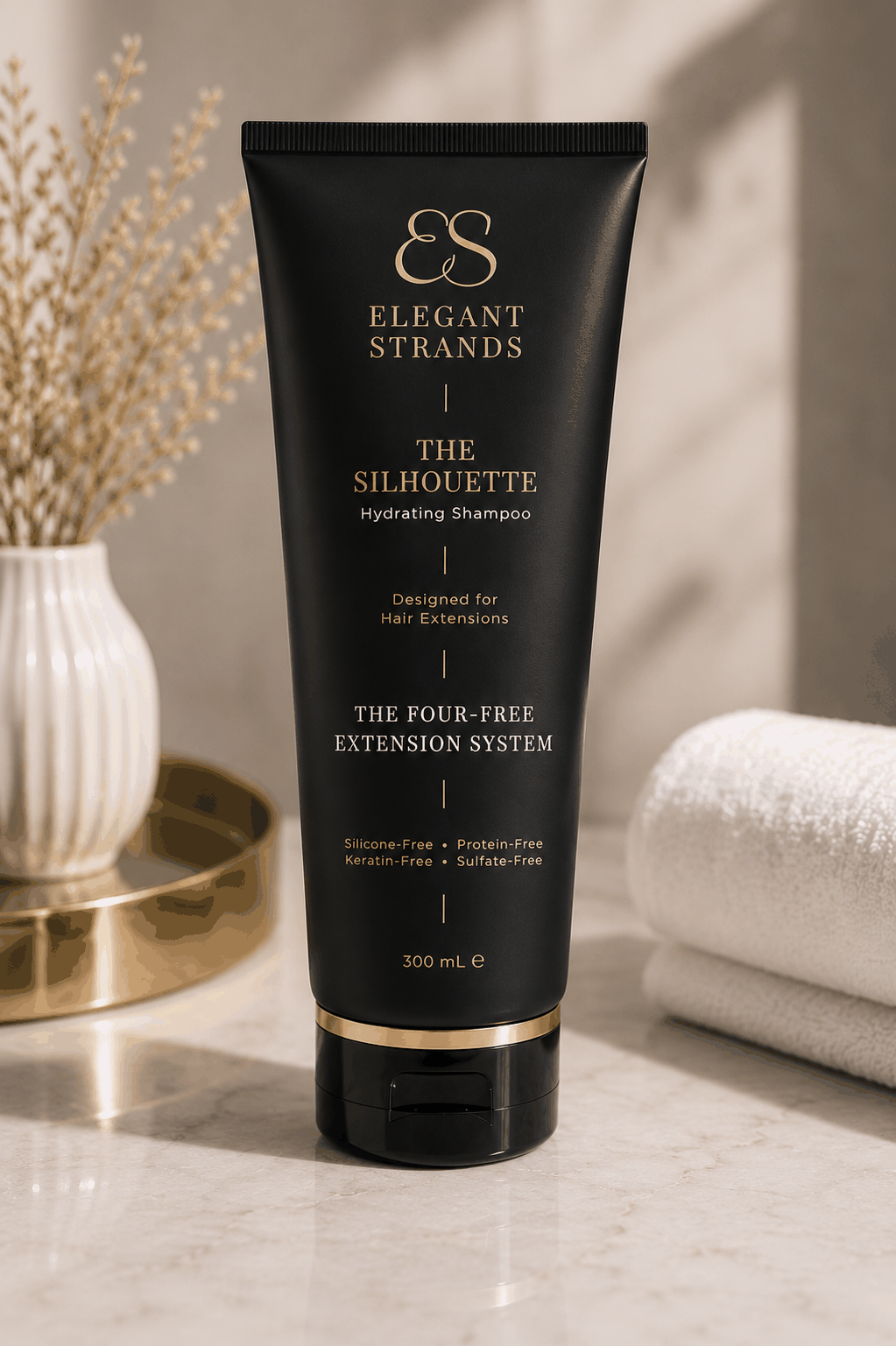
THE SILHOUETTE — Hydrating Shampoo | 300 mL
A hydrating shampoo designed to cleanse the scalp as part of an extension-safe washing routine.
THE EMBRACE — Nourishing Conditioner | 300 mL
A nourishing conditioner designed to soften and smooth the mid-lengths and ends.
THE VAULT — Intensive Hair Mask | 250 mL
An intensive conditioning treatment designed to improve softness and manageability in dry-feeling hair.
THE ELIXIR — Lightweight Hair Oil | 100 mL
A lightweight finishing oil designed to smooth the appearance of frizz and add shine.
Together, these products create THE COMPLETE RITUAL, our four-product haircare system.
Explore our Elegant Strands Professional Haircare Collection.
How to Use the Elegant Strands Haircare Ritual
When using the complete Elegant Strands Professional range, follow this routine.
Step 1 — Shampoo twice: Cleanse the scalp with THE SILHOUETTE, rinsing after each wash.
Step 2 — Apply the mask: Use THE VAULT through the mid-lengths and ends, keeping it away from extension attachment points, then rinse.
Step 3 — Follow with conditioner: Apply THE EMBRACE through the lengths and rinse thoroughly.
Step 4 — Finish with oil: Apply a small amount of THE ELIXIR to towel-dried mid-lengths and ends before styling.
For later washes, alternate the mask and conditioner according to your hair's needs.
For extension wearers, avoid applying conditioning products and oils directly to tapes, bonds or other attachment areas unless your specialist recommends otherwise.
Is Protein in Haircare Necessary for Healthy Hair?
Hair naturally contains structural proteins, but this doesn't mean everyone needs regular cosmetic protein treatments.
A suitable routine depends on your natural hair texture, condition and processing history.
Healthy haircare may involve gentle cleansing, conditioning, reducing unnecessary heat and avoiding excessive mechanical damage.
Some people like the results of protein-containing products, while others prefer different formulations.
Neither preference automatically proves that one category is always better.
Protein in Haircare for Curly, Coily and Colour-Treated Hair
Curly and coily hair can have different conditioning and styling requirements depending on its texture, density and previous processing.
Similarly, bleached or colour-treated hair may be more vulnerable to mechanical wear.
Protein-containing treatments may suit some individuals, while others find moisture-focused products more manageable.
The important thing is not to assume that everyone with curly, coily or processed hair needs the same product.
Consider how your hair feels, responds to washing and behaves during detangling.
How to Read Haircare Ingredient Labels
When comparing products, look beyond the front label and review the ingredient list and directions for use.
A product containing hydrolysed protein isn't automatically a high-protein treatment.
Ingredient lists generally don't reveal the precise concentration of every ingredient.
The complete formulation matters more than any single term.
For independent Australian information about cosmetic ingredient labelling and related requirements, visit the Australian Industrial Chemicals Introduction Scheme (AICIS).
Hair Extension Aftercare Beyond Protein
Protein in haircare is only one consideration when looking after extensions.
Daily brushing, suitable washing techniques, careful drying, reduced friction and regular professional maintenance are also important.
Your extension method affects how you should care for tapes, bonds, beads and weft rows.
Avoid applying heavy products directly to attachment points unless advised by your specialist.
Learn more about our Hair Extension Services in Craigieburn.
Frequently Asked Questions About Protein in Haircare
Is protein in haircare good or bad for your hair?
Protein ingredients can be useful in certain conditioning products, but they aren't necessary for every person. Results depend on the type of protein, the complete formulation and your hair's individual needs.
Can protein overload make hair dry or brittle?
Some people describe stiff or rough-feeling hair after repeated protein treatments as protein overload. However, this isn't a precise diagnosis, and dryness or brittleness can have several causes, including heat damage, chemical processing or unsuitable products.
Should I avoid protein in haircare if I wear extensions?
Not every extension type requires a completely protein-free routine. Follow the recommendations supplied by your extension specialist or hair manufacturer. Elegant Strands Professional uses protein-free formulas as part of its own extension-focused approach.
Protein in Haircare: Final Advice
So, is protein in haircare good or bad?
It depends on the product, its complete formulation and the needs of your hair.
Protein-containing treatments may be helpful for some people, while others prefer conditioning routines without added protein or keratin.
The important thing is to avoid treating a single ingredient as the answer to every hair concern.
At Elegant Strands Professional, we've chosen a coordinated, moisture-focused range formulated without added protein, keratin, silicones, sulfates, parabens or drying alcohols.
Our priority is to offer products designed with extension aftercare in mind while helping customers make informed decisions about their haircare routines.
Elegant Strands Professional — Luxury Haircare, Designed for Extensions.

Written by jennylea lankester